Creative Experiments with Reve
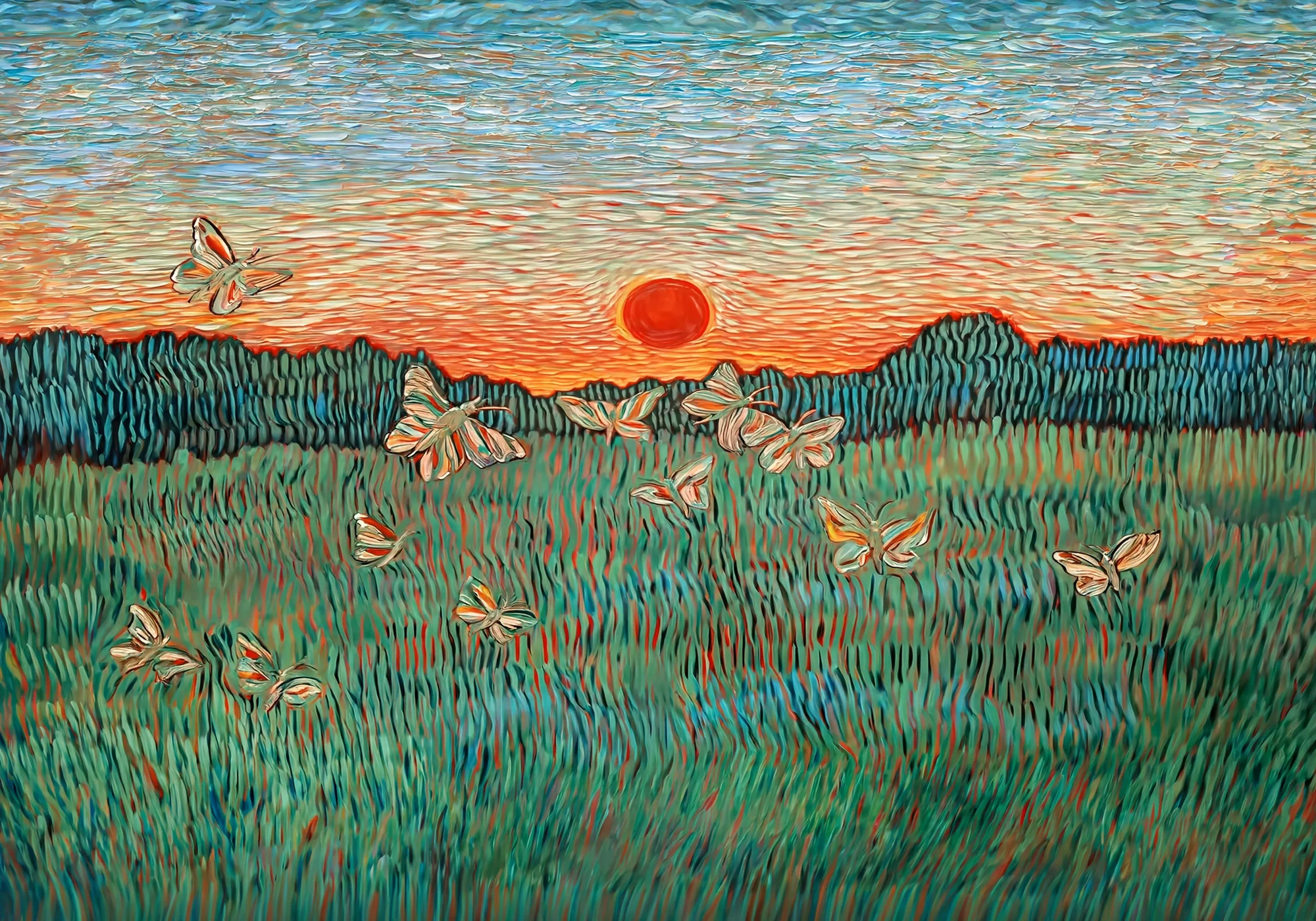
Butterfly Sunset by Michelle Liu.
Software tools shape how we think. Today, we are celebrating three experimental projects that explore new modalities for art-making with Reve, spanning vector spaces of abstract meaning, immersive 3D galleries, and nostalgic sticker collages. At Reve, as we tackle creative technology, we find that innovation shines brightest when we build entry points into our own imagination.
Here is a look at what happens when designers and creative technologists reimagine the canvas.
Imagespace by Angelina Wu
Imagespace bridges quantitative data and qualitative expression, allowing creators to map abstract thoughts into visual coordinates. By defining your own custom axes of meaning, it lets you explore parallel universes of visual material, seeing how subtle shifts across linear algebra and abstract concepts reshape an entire visual space.
Who are you as a designer?
I'm Angelina, a designer passionate about inspiring delight and human connection.
What is Imagespace, and what does it allow creators to do?
In Imagespace, you can define your own axes of meaning, turning absurd or abstract concepts into coordinates in a vector space.
What inspired the concept behind the project?
This project was inspired by many things, including image generation tools, political compasses, qualitative and quantitative data, and linear algebra. I wanted to explore what happens when you give structure to abstract human ideas and let them guide visual generation.
Digital Gallery by Michelle Liu
Digital Gallery translates the tactile serendipity of wandering through a museum into an interactive digital space. Visitors can wander through a 3D gallery featuring works from the Metropolitan Museum of Art, using spatial discovery to make direct digital studies and generate new art inspired by masterworks.
Who are you as an artist and designer?
I'm Michelle, an artist and designer who loves crafting tools for creativity and connection. I studied Art and Cognitive Science at UCLA.
What did you build for this project?
I built an interactive 3D gallery where you can explore artworks from the Metropolitan Museum of Art, then use them as creative inspiration for generating your own art with Reve.
What inspired you to recreate a physical gallery experience?
I've always wanted to recreate the feeling of wandering through a physical gallery in a digital space. This project was my attempt to bring that spatial sense of discovery and inspiration to life.
Sticker Scene by Emily Shen
Rooted in developmental psychology, Sticker Scene brings the warmth and uninhibited play of childhood collage into digital art-making. It propels a turn-by-turn transformation, letting you drag, drop, and layer individual sticker elements before resolving them into a single, cohesive artwork.
How does your background inform your approach to creative design?
Coming from a developmental psychology background, I've always been drawn to the pure creativity of childhood, the years before societal expectations start shaping what ideas are "allowed." Even now, as I push myself to explore new concepts in my product design work, I keep coming back to designing for that invaluable human warmth and connection.
What is Sticker Scene, and who is it designed for?
Sticker Scene is a sticker collage tool that turns your arrangement into a whimsical, finished piece of art, built to spark childlike wonder. You can drag and drop Reve-made stickers (or create your own), arrange them into a scene, and watch your craft become one coherent, personalized image. It's designed as a simple, delightful entry point for the young next generation of creatives to explore what's possible with Reve.
What sparked the idea for a sticker collage tool?
I was inspired by Reve's "What is an image?" video and the idea that creating with Reve feels like making a fluid collage. I wanted to explore Reve's ability to take in multiple reference images (the different stickers) and a reference style from a dropdown menu to create a cohesive story in the final generated image.
These three projects show how vastly different entry points, whether rooted in vector math, spatial memory, or childhood play, can unlock entirely new ways of seeing and making. We are constantly inspired by how our community takes these capabilities and turns them into something uniquely personal, playful, and human.