Teaching the Future with C.J. Yeh and Christie Shin

The future breathes first in the classroom. It is where the creative spark catches, where people play with beginnings: the experimental, the unfinished, the now. It is where Reve is headed.
C.J. Yeh and Christie Shin have spent their careers teaching at this exact edge. The nurturing of that moment is crucial.
As lead faculty at the Fashion Institute of Technology (FIT) and principals at the award-winning Cynda Media Lab, they move between practice and pedagogy at the frontier of creativity and technology, with over 60 international design awards and a client list spanning Google, MIT, and Starbucks. When AI began reshaping the design landscape, they invited it in, and handed their students the tools.
This semester, that meant introducing Reve into their AI-Assisted Design curriculum to help students move past "blank page" paralysis and into high-fidelity creative conviction. Students used Reve to materialize original brand worlds from scratch, building original visual languages that serve as the momentum for their final designs.
"Design reflects life. Human behavior, society, and evolving needs. When a tool, whether AI or otherwise, has the potential to amplify learning and expand creative capability, it belongs in the classroom."
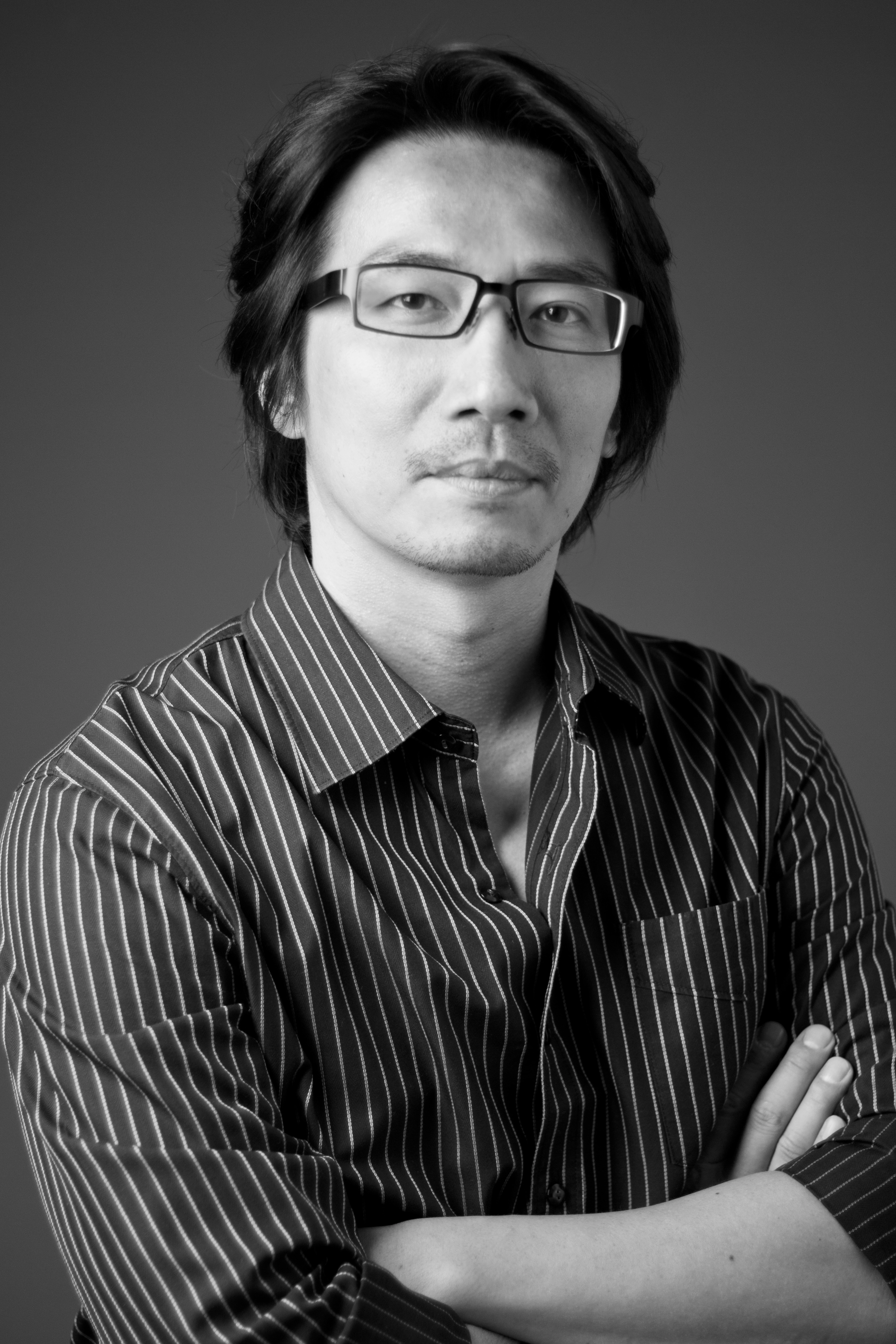 C.J. Yeh
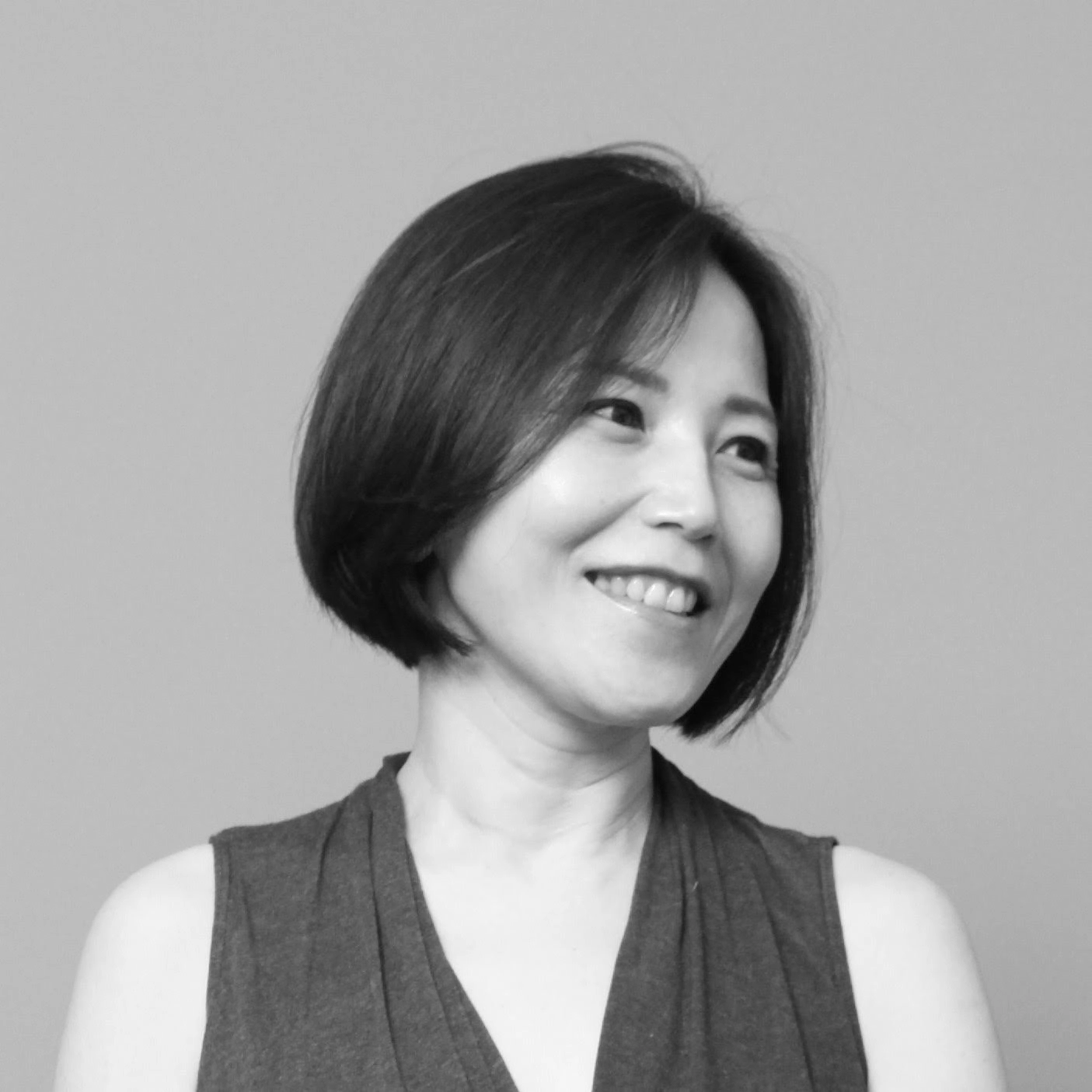 Christie Shin
Christie and C.J. have spent their careers asking the hardest questions about creativity, technology, and what it means to educate and create at the frontier. As we bring Reve into university classrooms, we were honored to sit down with them, to discuss the artist's role in an automated world, the responsibility of the educator in the age of AI, and how they are shaping the designers of tomorrow.
On Reve in the Classroom
You've both been at the forefront of introducing new technologies into design education, from the rise of UX/UI and inclusive design, to the integration of new AI-powered tools. When do you know something belongs in the classroom?
CJ: I’ve always believed that design education cannot exist in a vacuum. I started teaching in 2001 and restarted my design studio, Cynda Media Lab (CML), in 2012 specifically to bridge the gap between academia and the industry. For me, a technology belongs in the classroom the moment it begins to fundamentally shift the professional workflow. By keeping my "fingers on the pulse" through CML, I can identify which tools are mere novelties and which ones are transformative. If a tool changes how we solve problems or how we collaborate, it’s my responsibility to ensure our students master it before they enter the job market.
CS: Design reflects life—human behavior, society, and evolving needs. When a tool, whether AI or otherwise, has the potential to amplify learning and expand creative capability, it belongs in the classroom. Our role is to explore its potential and thoughtfully integrate it into the learning experience.
What is essential in a classroom when you're teaching something that doesn't have established rules yet, and how do you build a methodology when the tool itself is still evolving?
CJ: When the rules haven't been written yet, the most essential element is psychological safety. Students need to feel that the classroom is a laboratory where "failure" is just a natural part of the creative process. In fact, they need to understand that we all learn more from our failures and from our successes.
We build methodology by focusing on creative principles rather than specific button-clicks. Since tools like Reve or ComfyUI evolve weekly, I focus on our "Five Pillars of Creative Intelligence." If students understand the core logic of brand strategy, identity systems, and user empathy, they can adapt to any tool, no matter how much the interface changes. We aren't teaching software; we are teaching a way of thinking that uses software as an accelerant.
"Reve keeps the creative intelligence with the designer while providing the muscle of rapid visualization, where the goal is to keep the creator's intent at the center of the hurricane."
CS: Research and development are core to my role as an educator. I actively explore emerging tools across multiple dimensions, then introduce them through project-based learning. This allows students to understand not just how to use a tool, but why it matters and how it can enhance their creative process.
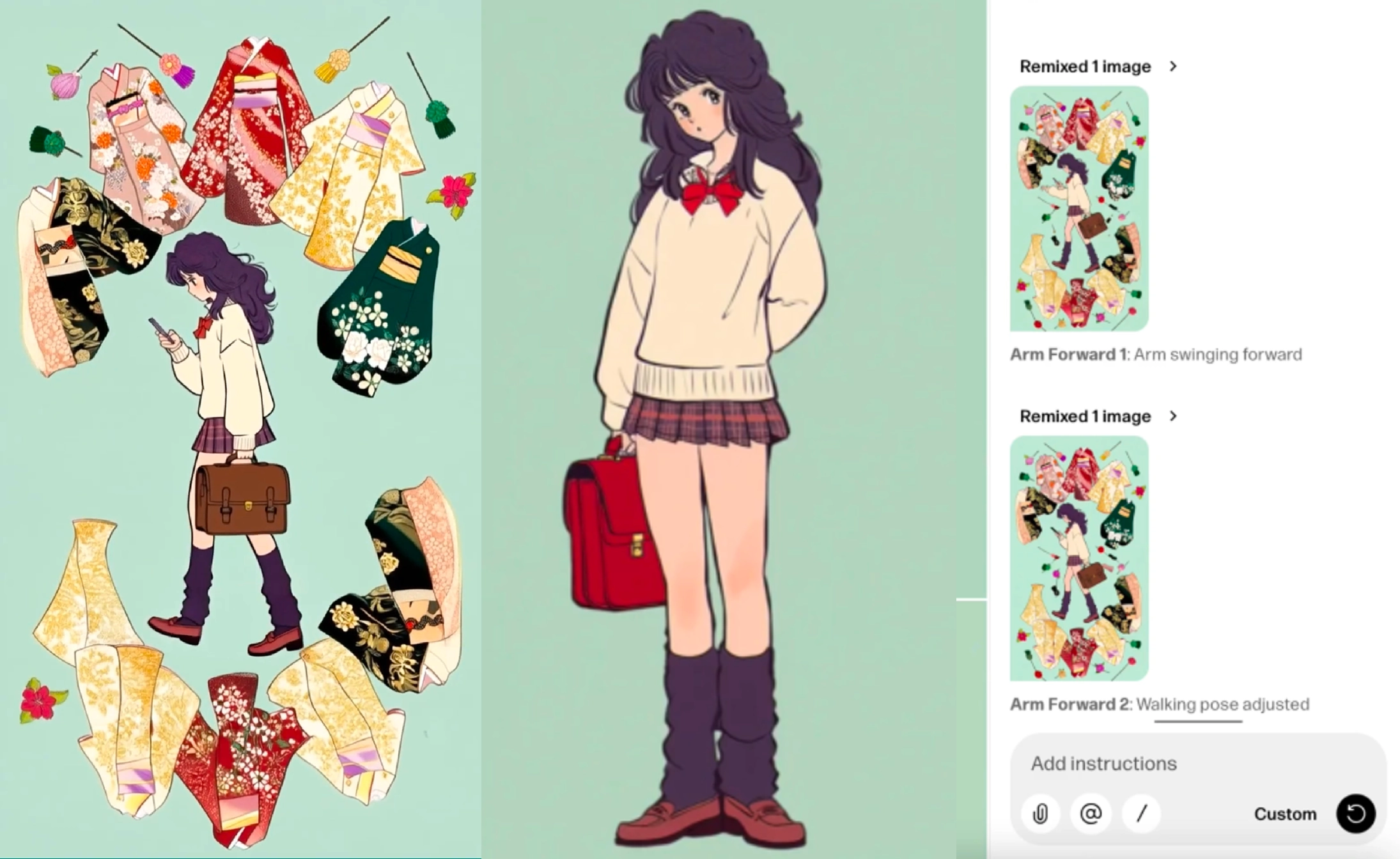
Kokona Akatsu, using Reve for character design and asset creation for Kansashi at Twenty — a campaign celebrating the Kansashi, a hair ornament worn for Seijin-no-Hi, Japan's coming-of-age ceremony. Each Kansashi is personal to each wearer, and Kokona used her own to model the asset.
When you introduced Reve in your AI-Assisted Design class, what surprised you most about how students responded? Were there moments where the tool pushed students somewhere unexpected, conceptually or creatively?
CJ: What surprised me most was the speed of ideation. Usually, there is a "blank page" paralysis where students overthink the first sketch. Reve acted as a creative sparring partner. It pushed students to explore visual directions they wouldn't have had the "technical courage" to try manually. I saw students who were traditionally "non-illustrators" suddenly producing complex conceptual compositions, which allowed them to focus on the story they were telling rather than their limitations with a stylus.
CS: We introduced Reve around Week 4, when students begin exploring text-to-image and image-to-image generation. By that point, they had already experimented with tools like Google Nano Banana and Flora, so they had a foundational understanding of generative imagery.
What stood out was the level of control students felt. Similar to Adobe Photoshop, Reve allowed them to craft images with intention rather than just generating outputs. That moment—when they realized they could direct and refine the outcome—was when they truly connected with the tool.
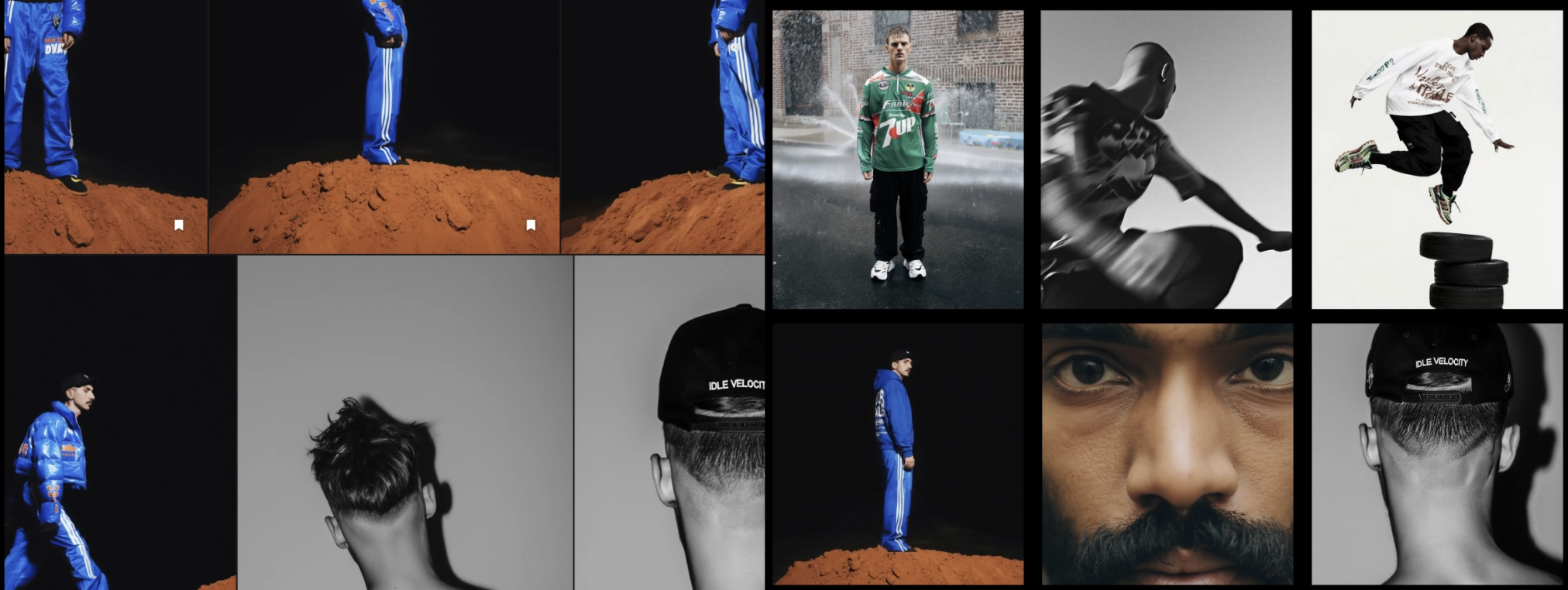
Brian Boggess, reinventing adrenaline and creating a brand identity inspired by a childhood in suburban Virginia, trail riding, and weekend racing.
At Reve, we want to preserve the creative process, enabling rapid prototyping while keeping control with the creator. If you were to design the ideal role for Reve in a curriculum, what would that look like in practice?
CJ: At the moment, the ideal role for Reve is as a Bridge Tool. In a curriculum, it belongs in the "Conceptual Development" phase. Instead of spending three weeks on mood boards that are just collections of other people's work to develop a design style, students use Reve to generate original mood boards and "V1" prototypes. It keeps the "Creative Intelligence" with the designer while providing the "Muscle" of rapid visualization, where the goal is to keep the creator's intent at the center of the hurricane.
CS: Reve is powerful for moodboarding and style exploration. With designer input, it can generate visual directions, and through iterative refinement, students can define and articulate a clear art direction.
What's something a student has made or said using these tools that you didn't expect, and that has stayed with you?
CJ: A student once told me, "I feel like I can finally see what’s in my head." That stayed with me because it reframed AI from a "replacement" to an "accessibility tool" for the imagination. It’s about lowering the barrier between a great idea and its visual manifestation.
CS: Across AI tools, one student shared something that stayed with me: AI unlocked their potential. They realized that mastering complex tools is no longer the only barrier—if you have strong ideas and a critical eye, you can be an excellent designer or art director.
That shift is powerful. It empowers students who have vision, even if they haven’t yet mastered every technical tool, to fully express their creativity.
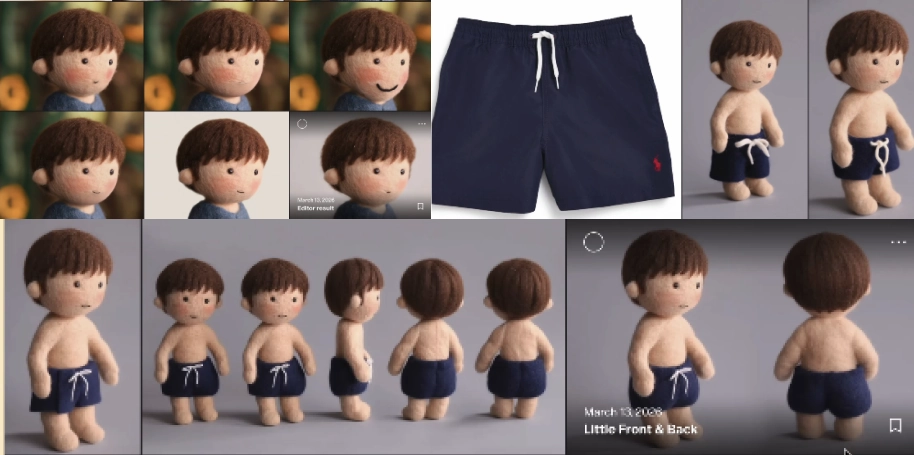
Elias Cherrier-Vickers crafting his character from references of his childhood in Florida. These character spec sheets were the building blocks of his short film, "MERBOY".
On teaching at the edge
How do you hold the tension and necessary conversation on what AI is reframing the craft, while still focusing on intentional progress?
CJ: There is a valid fear that AI might "thin out" the craft, but I see it as a fundamental reframing of where creativity actually lives.
Think about the profession of architecture: Architects don't mix the concrete or manually tighten every bolt. Machines and specialized industrial processes do those things now. Yet, no one ever questions the architect’s role as the creative genius behind the structure. They are the visionaries who understand spatial logic, human experience, and structural integrity.
I don't see why other design professions shouldn't work the same way. We are moving from being the "builders" who manually manipulate every pixel to being the "architects" of visual systems. We hold the tension by acknowledging that while the manual labor of design is being automated, the intellectual labor. The strategy, the "Creative Intelligence," and the intentionality becomes more valuable than ever. Focusing on intentional progress means teaching students to embrace this shift, moving from being technicians of a tool to being masters of the vision.
We aren't teaching software; we are teaching a way of thinking that uses software as an accelerant.
CS: Ultimately, humans remain the orchestrators. Designers guide agentic workflows, make decisions, and define intent. AI expands possibilities, but creative direction and judgment still come from the designer.
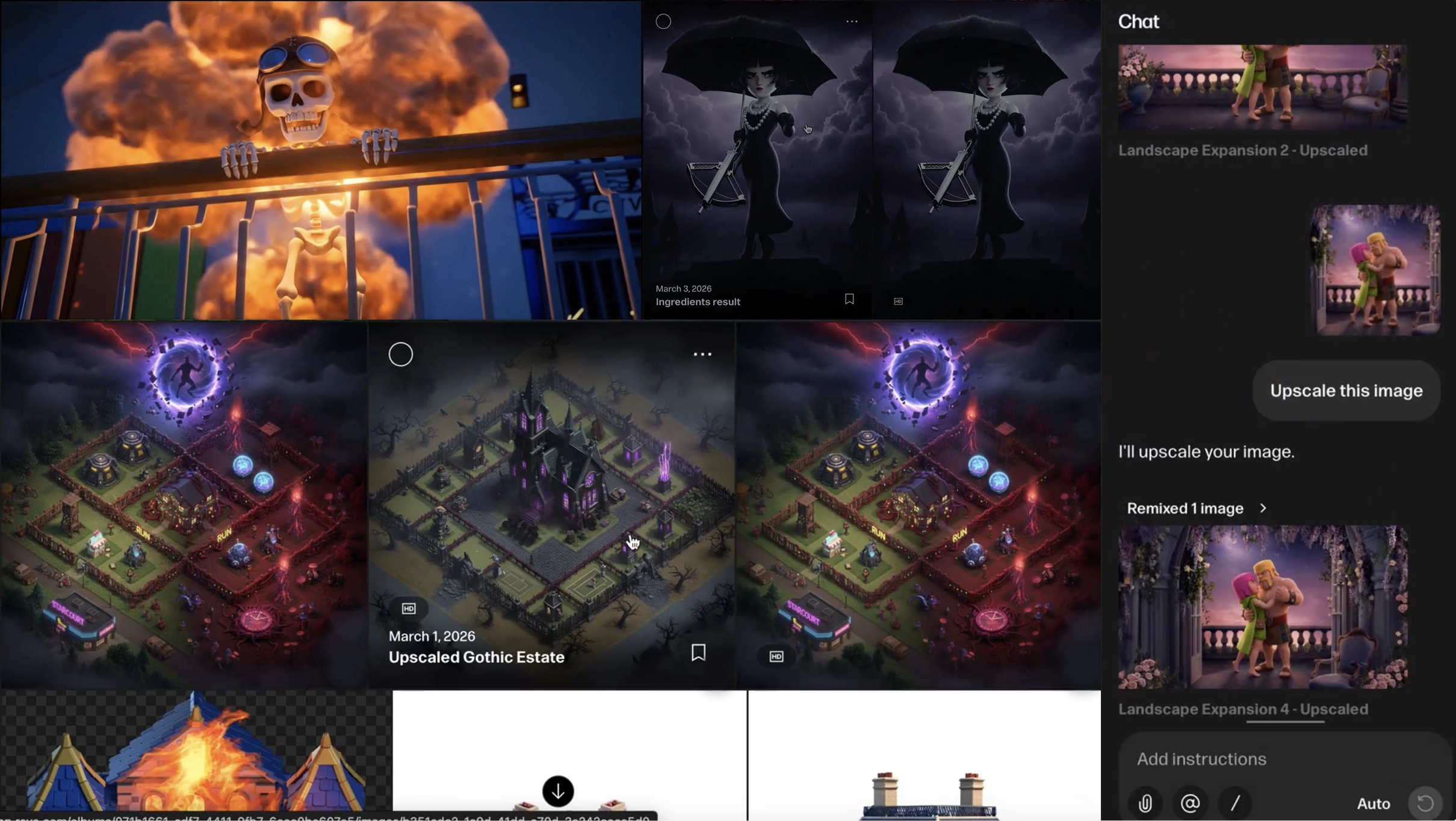
Vashtie Persaud & Thalia Merino, using Reve to generate characters, settings, and scene concepts for a campaign combining popular worlds that audiences already love.
As both practitioners and educators, how does your own creative work inform your teaching? What are you each making or researching right now that's shaping how you think about all of this?
CJ: My creative practice is split into two halves: the experimental and the practical. On the experimental side, I use my fine art practice to explore the "what ifs" ranging from video installations, conceptual art, Net.Art, AR to even NFTs. These experiments allow me to push a medium to its breaking point without the constraints of a client brief.
On the practical side, CML keeps me grounded in the evolving design industry. Currently, I am deeply focused on the agentic design process and AI-assisted workflows. I believe every technological paradigm shift is an opportunity for a new generation of "design heroes" to emerge. Like it or not, AI is here to stay. My mantra has become: AI will not replace designers; designers who use AI will replace designers who don't. My research right now is dedicated to defining that "human-in-the-loop" synergy.
We are moving from being the builders who manually manipulate every pixel to being the architects of visual systems.
CS: My goal as both a designer and educator is to reduce the gap between abstract knowledge and practical, hireable skills. I teach what I actively use in my professional practice. I often ask: What qualifications do I look for when hiring a junior designer? Those are the exact topics I bring into the classroom.
Right now, I’m deeply exploring Claude (particularly Claude Cowork) and agentic workflows—specifically how AI can help build and scale design systems. I’m interested in how these tools can create a more concrete foundation for design thinking while enabling scalable, systemic approaches.
We started the Faculty Partner program because we believe the most important conversations about AI in education are happening in studios and classrooms, not boardrooms. As we launch it with you, how do you imagine a curriculum looking in three years? What's one piece of advice you'd want faculty to have on why this experimentation matters now?
CJ: I believe we will be in a "Post-AI" society in three years. By then, AI won't be a buzzword or a separate category in the course catalog. It will simply be a natural, invisible part of the creative process, much like the way we view the internet or digital typography today.
History shows us that when the novelty of a new technology finally subsides, that is when true creativity begins to shine. We stop focusing on how the tool works and start focusing on what we can express with it. In three years, the curriculum will shift away from technical prompting and back toward deep conceptual strategy and "Creative Intelligence."
My advice to faculty is this: Don't wait for the dust to settle. This period of experimentation matters right now because we are currently defining the new standards of our industry. If you don't play with these tools while they are evolving, you won't understand how to guide your students when the technology becomes standard. We have to be willing to be "beginners" alongside our students so we can help them navigate the transition from novelty to true creative mastery.
CS: I believe we need a fundamental transformation of the curriculum. Foundational skills remain essential, but we must fully embrace emerging technologies to enhance and expand our workflows.
If academia remains status quo, the value of higher education will diminish. Instead, it should function as a playground and laboratory—a space to push creative potential using all available tools.
Experiment now. This moment is critical. The classroom is where the most meaningful conversations about AI in design are happening, and faculty play a key role in shaping that future.
Christie Shin is a professor at the Fashion Institute of Technology (SUNY) with over 30 years of experience in branding, UX/UI, and digital product design. She serves as Curriculum Committee Chair and Co-coordinator of Creative Technology & Design, and received the SUNY Chancellor’s Award for Excellence in Scholarship and Creative Activities (2023–24). A Pratt Institute alumna, she is also Partner and Design Director at Cynda Media Lab, an award-winning studio recognized with over 60 international design awards. She is the founder of the Design Portfolio Center and co-founder of DSGN BY D., and regularly lectures globally, bridging academia and industry.
C.J. Yeh is a creative director, educator, and author with 30+ years of experience in design. He co-founded Cynda Media Lab, where he leads branding, AI-assisted design, and UX/UI work for clients including MIT, Google, and Starbucks. A prolific writer and researcher, he has published ten books and written extensively on art and technology since 1999 — with essays featured in Art and Collection Magazine, ArtNow, and Artists Magazine, among others. His work has been exhibited at the Queens Museum of Art, MAXXI Museum in Rome, and the National Taiwan Museum of Fine Arts, and reviewed by The New York Times and Brooklyn Rail. He has spoken at TEDx and the Innovation Summit at the United Nations, and received multiple teaching awards for his work mentoring the next generation of designers.
Explore the Program & Student Gallery for further work from Christie and CJ's departmetns.